Horticulture Lighting Group: The Benchmark Quantum Board LEDs
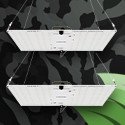
Horticulture Lighting Group is THE brand that revolutionized LED lighting for indoor growing with its famous quantum boards. These ultra-thin panels concentrate hundreds of Samsung LM301 diodes for exceptional light output and homogeneous distribution. Frankly, since HLG popularized this technology, it's hard to overlook their solutions when seeking performance and energy efficiency.
HLG quantum boards deliver up to 2.9 µmol/J, nearly 40% more than an equivalent HPS. Their flat design allows for better heat dissipation and avoids hot spots that used to scorch leaves with older generations of LEDs. This is exactly what's needed to optimize photosynthesis without overheating the grow space.
Why choose Horticulture Lighting Group LEDs
The strength of HLG lies primarily in their light efficiency. With Samsung LM301B and LM301H diodes, they achieve yields that were unthinkable a few years ago. A 240W HLG panel easily replaces a 400W HPS while consuming 40% less. The electricity bill matters over a full season.
Regarding spectrum, HLG has done a great job. Their full spectrum quantum boards perfectly cover plant needs from germination to harvest. The 3000K spectrum with 660nm red diodes is the sweet spot for most crops. No need to juggle between multiple lights depending on the phases.
The construction also makes a difference. Quantum boards use thick aluminum PCBs that efficiently dissipate heat. The result: diodes stay cool and maintain their efficiency over time. HLG announces 50,000 hours of operation, which is more than 5 years at 12/12. It's built to last.
How to choose your HLG lighting
To choose the right HLG model, it all starts with the area to be lit. Count approximately 30-35W per square foot (or 320-380W/m²) for optimal lighting. An 80x80 cm tent therefore requires a minimum 200-240W panel. The HLG 260 or 320 models are perfect for this setup.
Ceiling height also influences the choice. HLG quantum boards are generally placed between 30 and 60 cm from the plants depending on the power. The more powerful the panel, the more distance is needed. Make sure your space allows for this distance without compromising vertical growth.
In terms of budget, HLG represents a higher initial investment than HPS, but the electricity savings and lifespan largely compensate. Not to mention that you avoid changing bulbs every year and can often do without additional air conditioning.
Frequently Asked Questions
Which HLG light should I choose for an 80x80 cm tent for indoor tomato cultivation?
For a surface area of 0.64 m², aim for a 200-240W HLG panel like the HLG 260 Quantum Board. This power delivers approximately 320W/m², perfect for tomatoes which require intense lighting. Place the panel at 45-50 cm height during growth, then move it closer to 35-40 cm during flowering. The 3000K spectrum of HLG is perfectly suited for tomatoes from seedling to harvest. With this setup, expect 12-15 hours of daily lighting depending on the variety.
How to adjust the HLG LED spectrum to transition from plant growth to flowering?
Most HLG quantum boards use a fixed full spectrum 3000K + 660nm red that is suitable for both phases. No spectral adjustment is needed, which is the advantage of this technology. To optimize according to phases, focus on intensity and photoperiod: 18h/6h during growth with 70-80% power, then 12h/12h during flowering at 100%. Some recent HLG models offer separate dimmers for whites and reds, allowing for fine-tuning of the ratio according to your needs.
Are HLG lights more efficient than HPS for a small area, and how many HLG watts compared to a 250W HPS?
Absolutely, HLG lights outperform HPS even in small areas. A 250W HPS delivers about 33,000 lumens or 0.4 µmol/J, while a 150W HLG panel reaches 2.7 µmol/J. Concretely, 150W of HLG largely replaces 250W of HPS while producing 60% less heat. In a small area, this is even more advantageous because it avoids overheating problems that require over-ventilation with HPS. The electricity savings are immediate: 100W less per day makes a difference on the bill.
What is the recommended installation height for HLG panels without burning leaves?
The distance depends on the power of the HLG panel. For a 150-200W model, maintain 35-45 cm during growth and 30-35 cm during flowering. 300W+ panels require a minimum of 50-60 cm. Monitor the apexes: if the top leaves yellow or curl, it's too close. HLG lights generate little heat but a lot of photons, so light stress occurs before heat stress. Use a lux meter or observe plant behavior: they will tell you if it's too intense.
How to clean and maintain HLG LEDs to extend their lifespan?
Maintenance of HLG quantum boards is minimal but crucial. Dust the panels monthly with a dry brush or a slightly damp microfiber cloth (panel off and cooled). Avoid chemical products that could damage the diodes. Regularly check that the heat sinks are not obstructed by dust, as this impairs cooling. Also check electrical connections and drivers: a poor contact can cause heating and reduce lifespan. With proper maintenance, HLG lights easily last their advertised 50,000 hours.